For a century, the light of one Mediterranean island pulled poets, painters and patrons across
oceans. This is the story of who came, who they became to one another, and what the world did to them, told in
five maps you can move through.
Begin
The Great Disruption
From Academy to Anarchy
At the turn of the twentieth century, Europe was being systematically rebuilt by the machine. Cities grew dense with factories, skylines choked on coal smoke, and human life was increasingly subjected to the rigid, mechanical rhythms of industrial production. This ordering of society extended deep into the state art academies, which taught artists to tame and rationalise nature, smoothing out its edges and document society safely within urban, institutional walls.
Then came the fracture. In rapid, overlapping waves: from Impressionism's capture of fleeting outdoor daylight to the raw, subjective emotional colors of Post-Impressionism and Fauvism; Modernism broke the classical rules. This was both an artistic and political act. To paint subjectively was an anarchic rejection of the standardized, collective logic of the machine age.
Artists actively fled the cities, seeking out idyllic, geographically extreme edges of the world where nature remained unmanaged and raw. They were looking for a sanctuary where individual expression could survive.
What they found was Mallorca and its blinding, unclassifiable light.
The Purest Manifestation
When the international avant-garde descended onto the northern coast of the island, they brought radical theories born in Paris and Barcelona. But they also encountered a local reality that bypassed the need for manifestos.
Among them was the young painter Dionís Bennàssar. Born into Pollença's working-class agricultural reality, he hadn't engineered a philosophy to escape the industrial machine; he simply lived outside of it.
Cosmopolitan circles of this era frequently carried an unstated sense of cultural superiority, often viewing local figures as "primitive" or purely folkloric. Yet the intellectual circle in Pollença recognized Bennàssar immediately: not as a local novelty, but as a peer. They realized that while the Europeans had to invent a philosophy to escape the industrial age, Bennàssar was already painting it from the inside out. He was the living embodiment of everything they had traveled across a continent to find.
I · The Golden Island
How a fishing island became a canvas
In the winter of 1838 a French novelist and a consumptive Polish composer took rooms in an
abandoned charterhouse at Valldemossa. George Sand and Frédéric
Chopin were miserable there (the rain, the suspicion of the locals) and Sand's book about the stay was
sharp-tongued. But the book existed, and with it Mallorca entered the European imagination as a place a serious
artist might go.
Others followed who loved it more. The Austrian Archduke Ludwig Salvator bought up the
coast between Valldemossa and Deià, lived there for forty years, and catalogued every cove and custom in his great
survey Die Balearen, making the Serra de Tramuntana famous across the courts of Europe. Then, at the new
century, the Nicaraguan poet Rubén Darío, the father of Spanish modernismo,
wintered in Palma and gave the island the name that stuck.
The island of gold.Rubén Darío, “la isla de oro”
What none of them quite started, the painters finished. Drawn by a quality of light that flattened the distance
between sea and mountain, a generation of artists arrived to treat the Mallorcan landscape not as a backdrop for
history or saints, but as the whole subject: alive, coloured, and worth crossing a continent for. Over the next
century the island gathered painters, poets, a composer, patrons and an architect into one of the
Mediterranean's most remarkable artistic colonies.
The colony in time & space
A century of arrivals
Before the people, the shape of the thing: when each figure came to the island, how long they stayed, and how far
they had travelled to get there. The map below sets the whole colony at dusk over the Bay of Pollença. Drag the
slider and watch the arrivals wash in across a hundred years.
Each lane is a figure's presence on Mallorca; the arc shows where they sailed from. Distance,
time, and arrival, in one view.
II · The Impressionist Renewal
The painters who came for the light
In 1893, and then in earnest from 1901, the Catalan painter Santiago Rusiñol made the
island his refuge, calling it l'illa de la calma, the island of calm. He came with his friend
Joaquim Mir, whose canvases of the ravines around Sóller pushed colour almost to
abstraction, and was joined by the marine painter Eliseu Meifrén, who took over Palma's
School of Art in 1910. In 1899 the Belgian symbolist William Degouve de Nuncques crossed
their path and left a mark on Mir's vision.
They did not work in isolation. At the old royal charterhouse of Valldemossa, Joan Sureda
and his wife, the painter Pilar Montaner, kept open house: the same rooms that received
Rusiñol also hosted Rubén Darío. And the renewal took local root: the Mallorcan painters Antoni
Gelabert and Joan Fuster Bonnín painted the Tramuntana alongside the visitors,
Fuster becoming the hinge between this generation and the one to come.
The makers
Not one kind of artist
A colony is a mix of crafts. There were the painters, of course (the great majority), but also poets and
novelists, a single famous composer, the patrons and hosts who made the rest possible, and an architect who built
one studio for a friend. Sorted another way, you can watch the island's very manner change: from Romantic
reverie, through the plein-air light of the renewal, to the vibrant chromatism of the Pollença School, and on to
the moderns.
That second lens is where technique lives: the bold, almost reckless colour the school became known for; the long,
loose brushwork; the experimental eye of a master who studied the seabed through a glass visor; and the native
painter who, after a war wound to his right hand, taught himself to paint with his left.
Toggle between what each figure made and the manner they worked in.
III · The Pollença School
An atelier crosses an ocean
By the time Hermen Anglada-Camarasa, then one of Europe's most celebrated painters, left Paris in 1914, the city he was abandoning had been remade by the machine. Factory smoke thickened its skylines; the logic of industrial production had colonised every corner of European life, including the academies, which taught painters to subdue and rationalise nature just as the engineers had subdued and rationalised the river. The Pollença colony's move to the north coast of Mallorca was not, at its core, a simple change of studio. It was a deliberate philosophical refusal: a declaration that the raw, uncomposed geology of the Serra de Tramuntana, its limestone cliffs unchanged over millennia and answering to no industrial schedule, offered the only honest subject left in Europe.
The move was triggered by the insistent letters of Anglada's Argentine pupil Francisco Bernareggi, who had already been painting the bay for years and who understood, before his master, that Port de Pollença was not merely picturesque; it was structurally extreme. Where the atelier went, its circle followed: Tito Cittadini, who would spend nearly fifty years on the island and become the school's intellectual backbone; the Argentines Gregorio López Naguil and Roberto Ramaugé; the Mexican Roberto Montenegro. An entire international studio relocated to one uncompromising bay.
They painted in the landscape, not the studio, but built a working life around the
port. Along the harbour front, the painters rented out the ground-floor storerooms the fishermen used between
seasons: the almacenes, their thick stone walls and north-facing apertures providing the steady, unwavering
light that large canvases demand. Their social headquarters was the Hotel Miramar, just
back from the waterfront, where the evenings became a running argument conducted in Spanish, French, Italian and
Catalan, over colour, theory, the right cove to paint tomorrow, the merits of the school's chromatism against the
naturalism they had all been trained in first.
The community's grandest expression took physical form in the early 1920s, when
Roberto Ramaugé purchased La Fortaleza, a 17th-century military fortress set on
the clifftops of the Albercutx peninsula above the port. He spent a considerable fortune on its transformation, adding eclectic architectural details, terraced gardens with views across the whole bay to the mountains, turning a Baroque fortification into the spiritual centre of the entire colony. At La Fortaleza, Anglada-Camarasa,
Cittadini and their circle gathered to paint, dine and mark the seasons in some of the most celebrated social
events the Pollença colony ever saw.
It drew patrons too. The Argentine poet Adán Diehl, smitten by an Anglada seascape,
bought the Formentor peninsula from the family of the poet Miquel Costa i Llobera and in
1929 opened the Hotel Formentor, turning the painters' quiet refuge into an international stage.
Where every evening, as the sun goes down, the painters put down their brushes to applaud.
Anglada-Camarasa, describing the bay to Adán Diehl
The school's most radical contribution was technical as much as visual. Where the academies had demanded that colour be carefully blended on the palette, naturalism achieved through the systematic erasure of the painter's hand; the Pollença painters refused. They laid pure, unmixed pigment directly onto the canvas: raw sienna straight from the tube, cobalt uncut by white, viridian applied in declarative strokes that made no pretence of describing nature as the academies said nature must be described. This was not carelessness. It was a flat rejection of bourgeois academic rules: a chromatic anarchy that ran precisely parallel to the political currents many in the circle had absorbed in Paris: libertarian, utopian, fiercely opposed to any received authority over the individual eye.
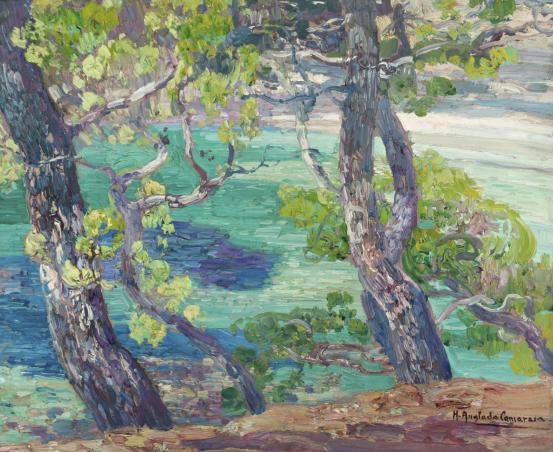
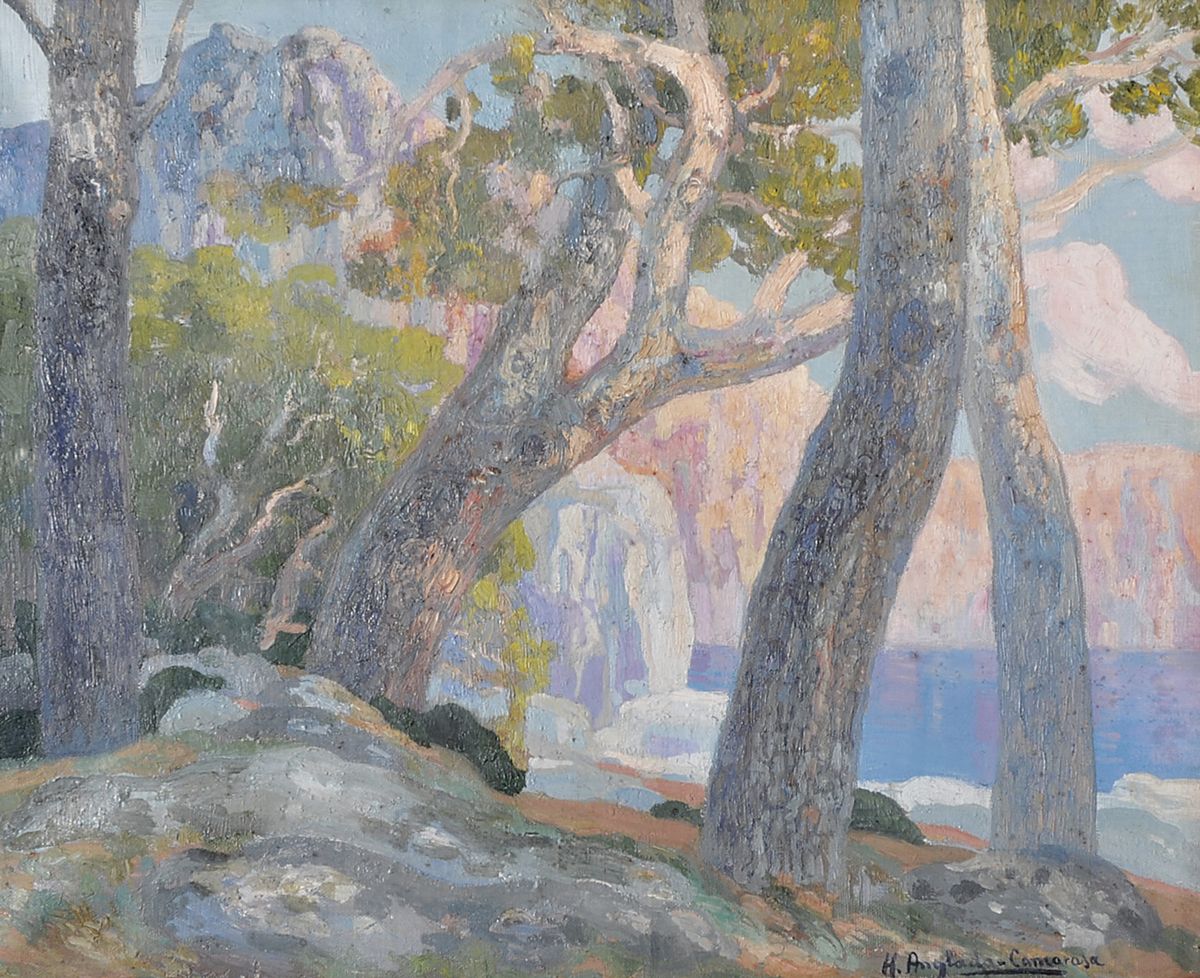
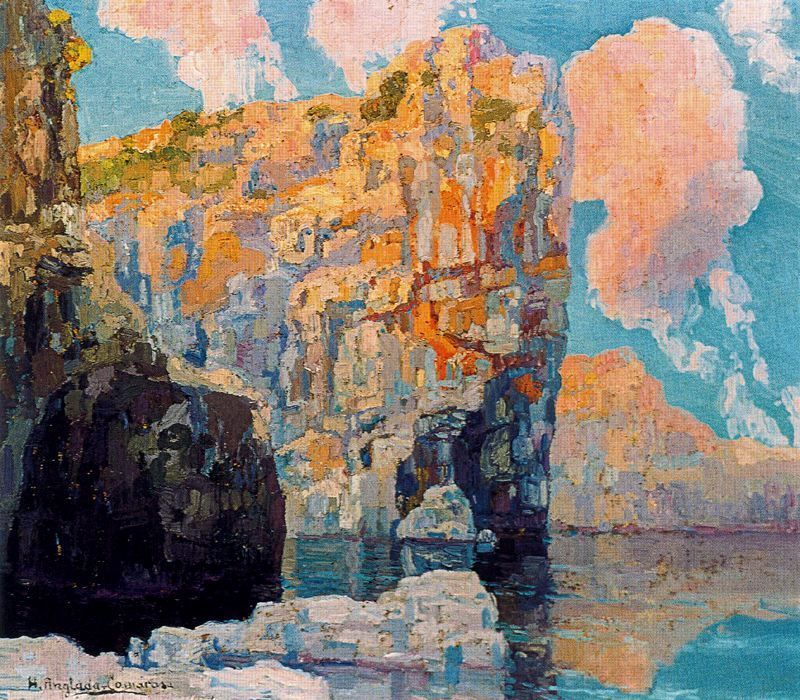
The result was a shared visual language unlike anything the island had produced before: limestone cliffs rendered in warm fire and cool shadow that no photograph could reproduce; the Mallorcan pine (its bark alive with unmixed mauve and copper) silhouetted hard against water that was turquoise because the painter insisted it was. It was a vision born in Paris, sharpened in Valencia and the south of France, and completed here, on this particular, geometrically severe bay. Other painters arrived to study at Anglada's feet and many stayed, held not just by the light but by the freedom the light demanded.
Anglada-Camarasa · the school's visual language
Pines over the bay · Anglada-Camarasa
Pines with coastal cliffs · Anglada-Camarasa
Cliffs at sunset · Anglada-Camarasa
The school's palette: pine bark in orange and white, the cliffs in gold and coral at sunset, the sea a layered blue shifting from turquoise to ultramarine. It became a shared grammar that the disciples absorbed and each inflected differently.
Born into the light
Dionís Bennàssar was born in Pollença in 1904 into the agricultural working class, the same rural world of stone walls, olive harvests, and fishing boats that the international painters had crossed oceans to romanticise. This is not an incidental detail. The Paris-trained circle around Anglada carried, alongside their paint boxes and colour theories, a genuine libertarian and utopian current: the belief that art's purpose was not to serve the academies or the bourgeoisie but to find the monumental in the vernacular, to dignify the life of ordinary people, to make visible what academic tradition had always looked past. In Bennàssar they found something rarer than a talented student. They found the thing itself.
He had not arrived at this landscape through theory. He was born into it. He knew the Pollença cliffs not as a discovery but as an inheritance, their light across every season of his life, the angle of the bay at midwinter and high summer, the colour the pines turned at the end of August. Where the foreigners had brought the avant-garde to the peasant landscape, here was the peasant landscape producing the avant-garde from within itself. The ideological logic of the school, its belief in the organic, the unmediated, the elevated dignity of the working world, made it impossible to treat Bennàssar as peripheral. He entered Anglada's orbit around 1926 not as a provincial outsider but as the living convergence of everything the school had come to Mallorca to find: the international circle's technical radicalism meeting, in one person, the authentic knowledge of the place those theories had been built to honour.
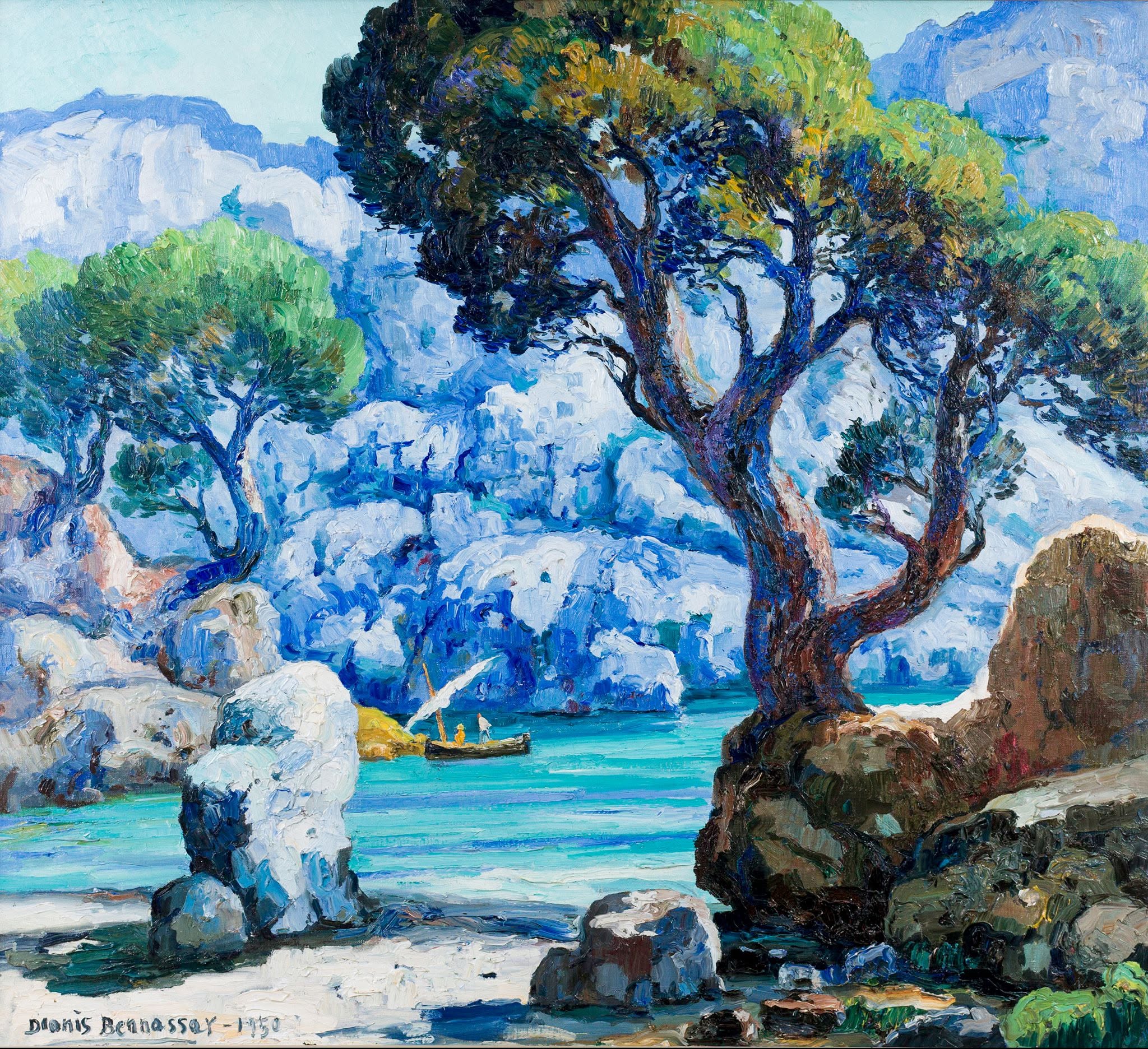
His early canvases show the school's influence clearly: the cool turquoise and blue-grey of the coves around Cala Sant Vicenç and Formentor, the compositional confidence of returning obsessively to the same subjects Anglada and Cittadini had already made their own. But the palette reveals a structural difference from the start: more embedded, the colour locked into the geology of the rock and the specific weight of the water rather than shimmering atmospherically over it. Where the foreigners painted the landscape as an emotional event, Bennàssar painted it as a physical fact, one he knew from the inside. The pure, unmixed colour he had absorbed from the school's chromatic anarchy was already being redirected: away from Parisian exuberance and toward something harder, more certain, more deeply local.
Bennàssar · early 1950s · colour and place
Pines and the bay · 1950
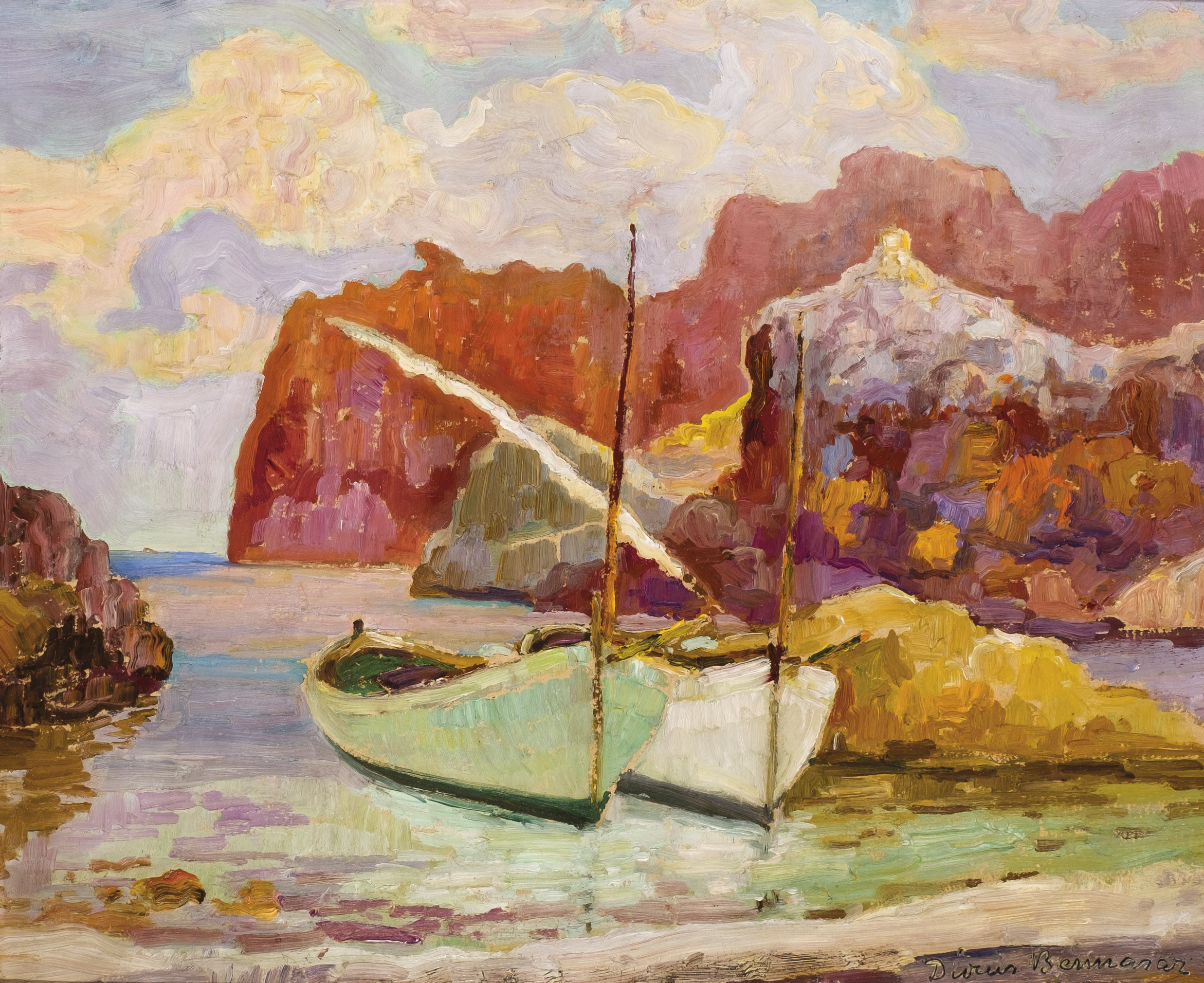
Boats at anchor · c. early 1950s
Two early subjects: the pine arching over the turquoise bay (a composition Anglada had made famous), and the boats at their moorings, with Bennàssar already showing the range of motifs, and the palette that is distinctly his, more structural than his teacher's atmospheric shimmer.
Testing what he had learnt: 1955–1963
Through the later 1950s and into the 1960s Bennàssar worked through the vocabulary he had inherited. The rocky
shores of Cala Sant Vicenç, the gorges of the Mallorcan interior, the harbour boats on their moorings: he returned
to the same places again and again, accumulating knowledge through repetition in the way that only a painter who
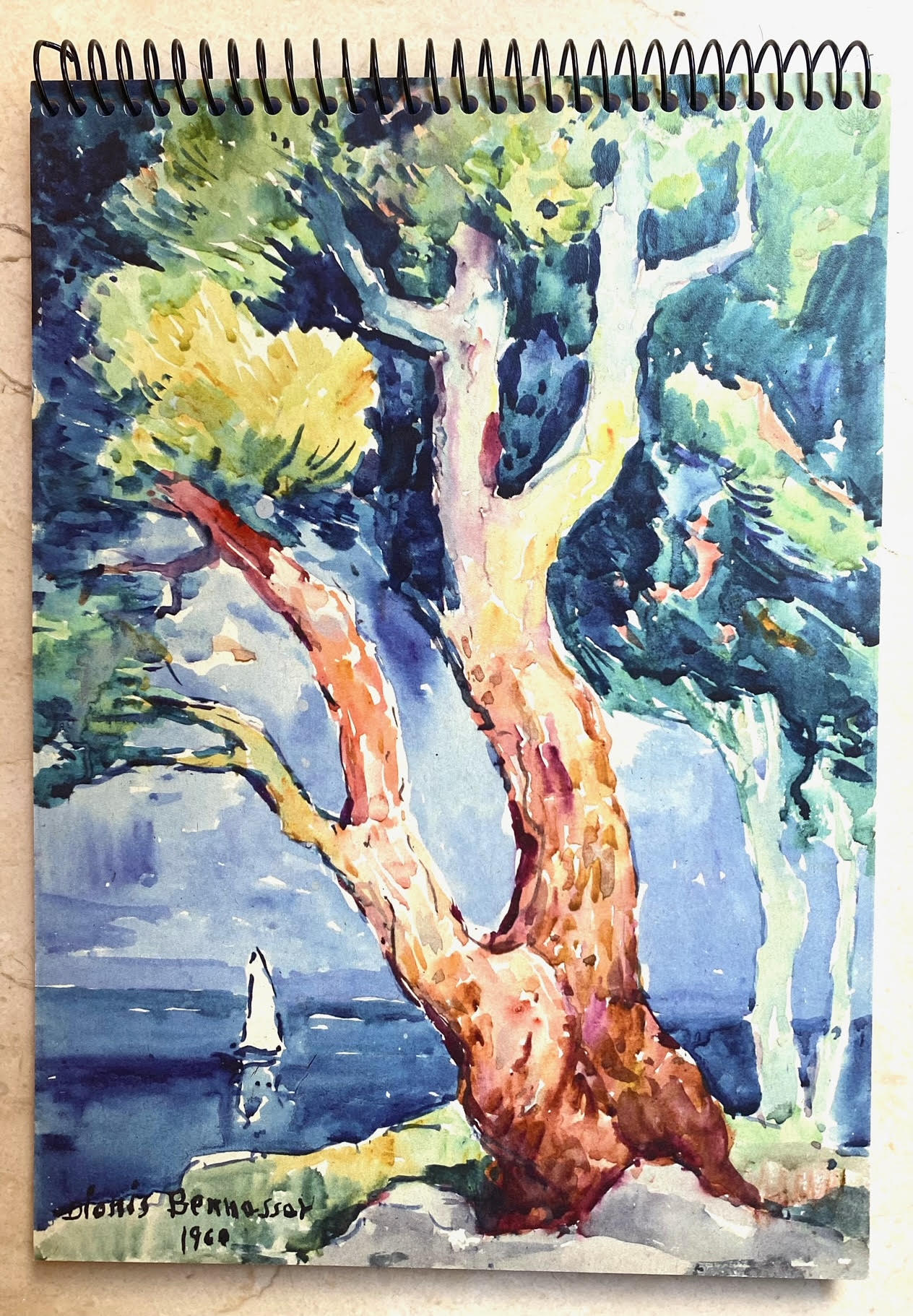
never has to leave can do. A watercolour sketchbook from 1960, its pages small and the brushwork fast, shows him
working through compositional problems in paint before committing them to canvas, the pine trunks in copper and
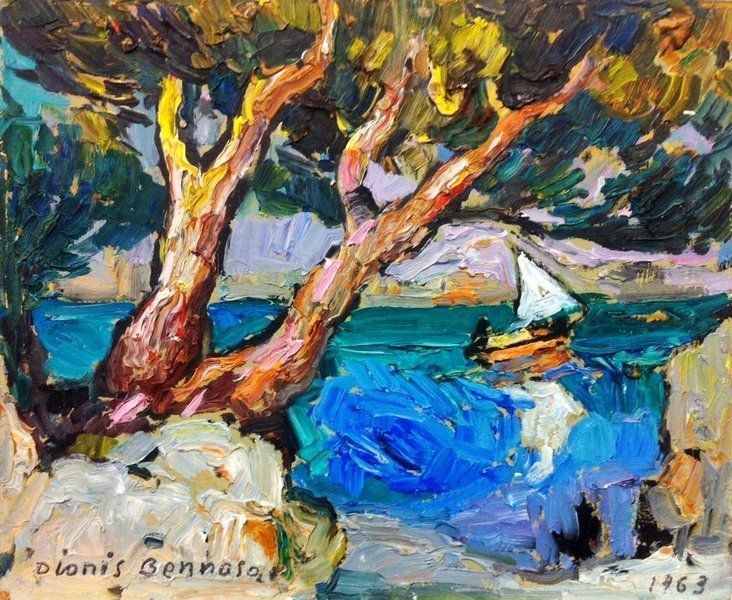
pink that no photograph would reproduce but that the hand insists on. By 1963 the colour is openly arbitrary:
a brushstroke of magenta in the bark because the eye demands it.
Bennàssar · 1955–1963 · colour grows declarative
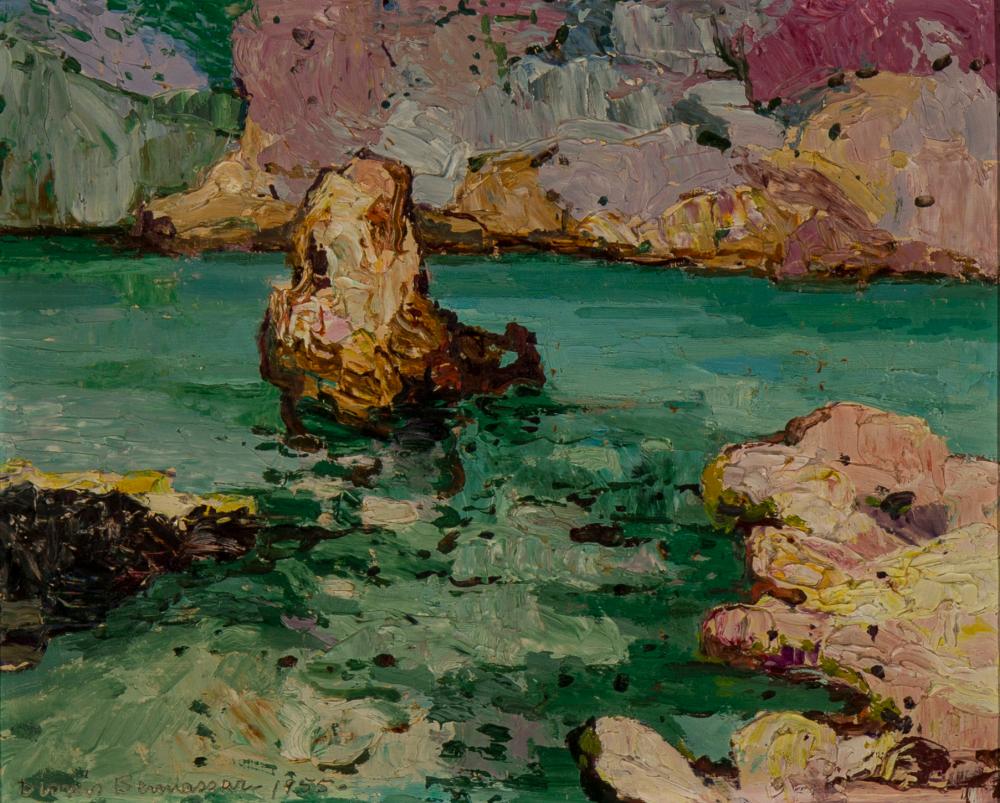
Rocky cove · 1955
Sketchbook study · 1960 · watercolour
Pine and sailboat · 1963
The cove's teal is a decision, not a record. By 1963 the bark is orange-pink because Bennàssar says it is. The Pollença school's lesson in chromatic freedom, fully internalised.
The full voice: 1966–1967
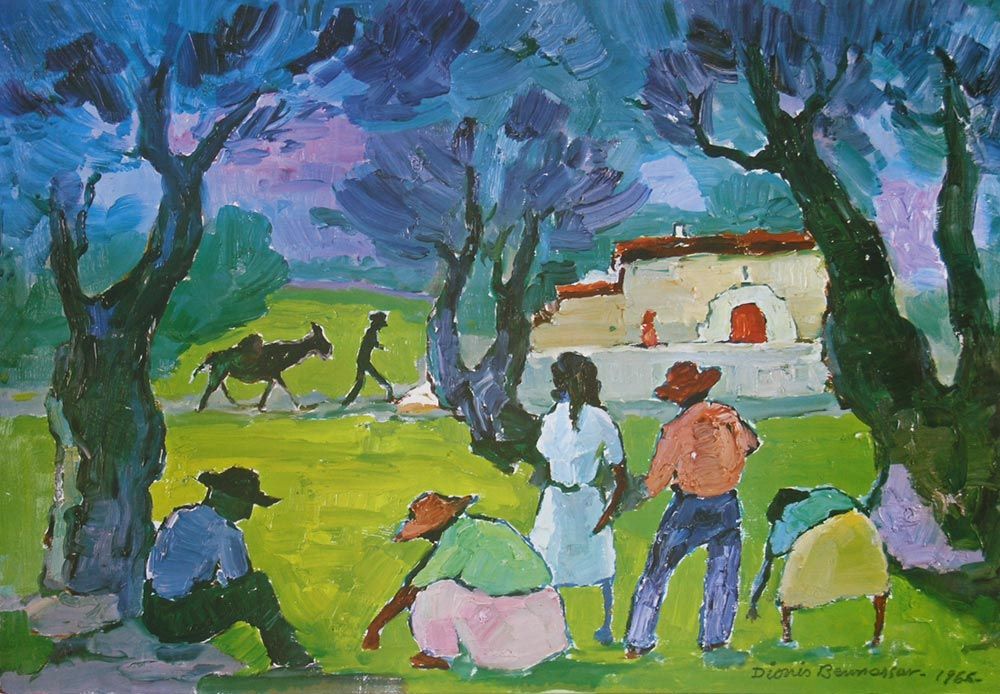
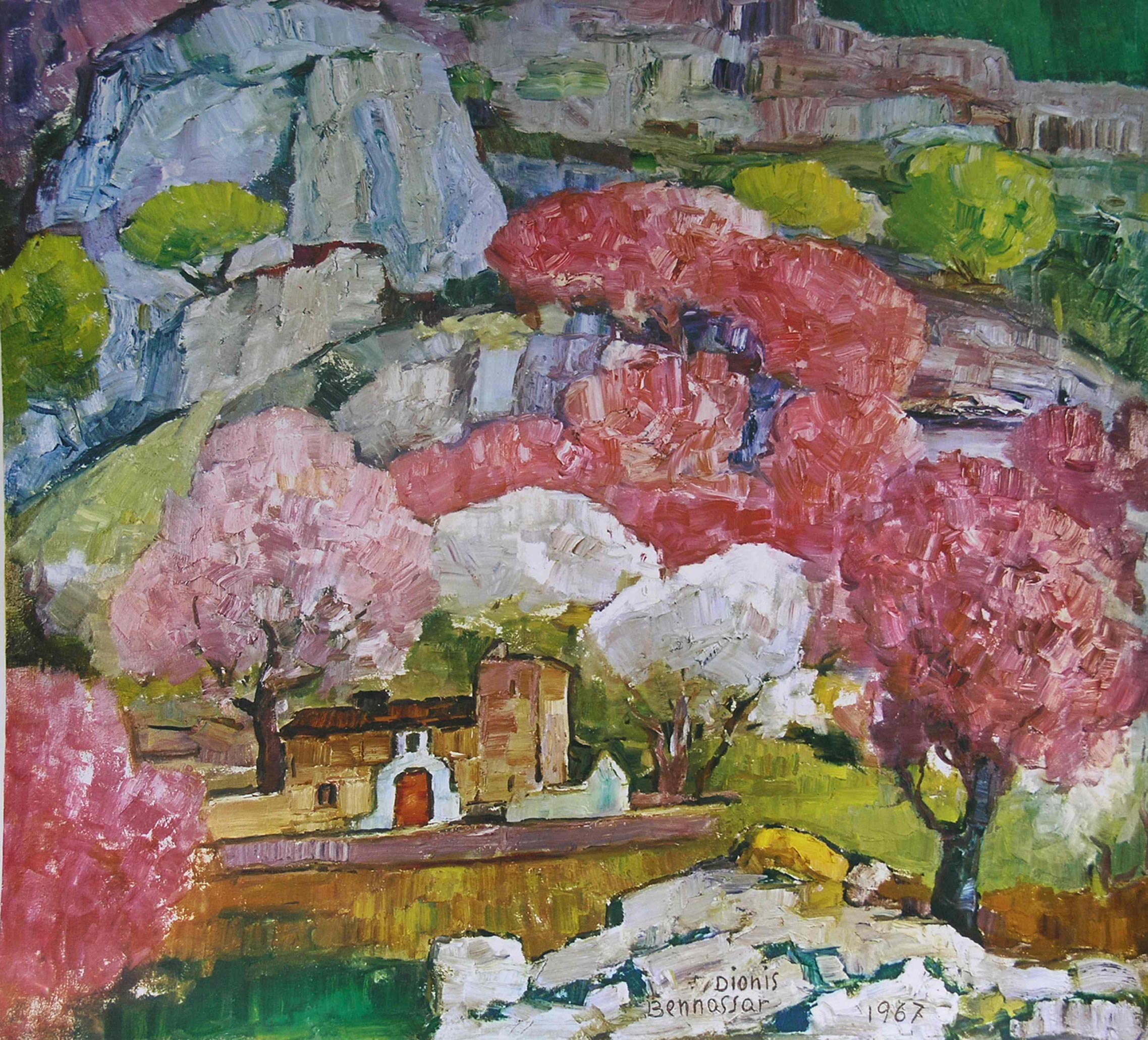
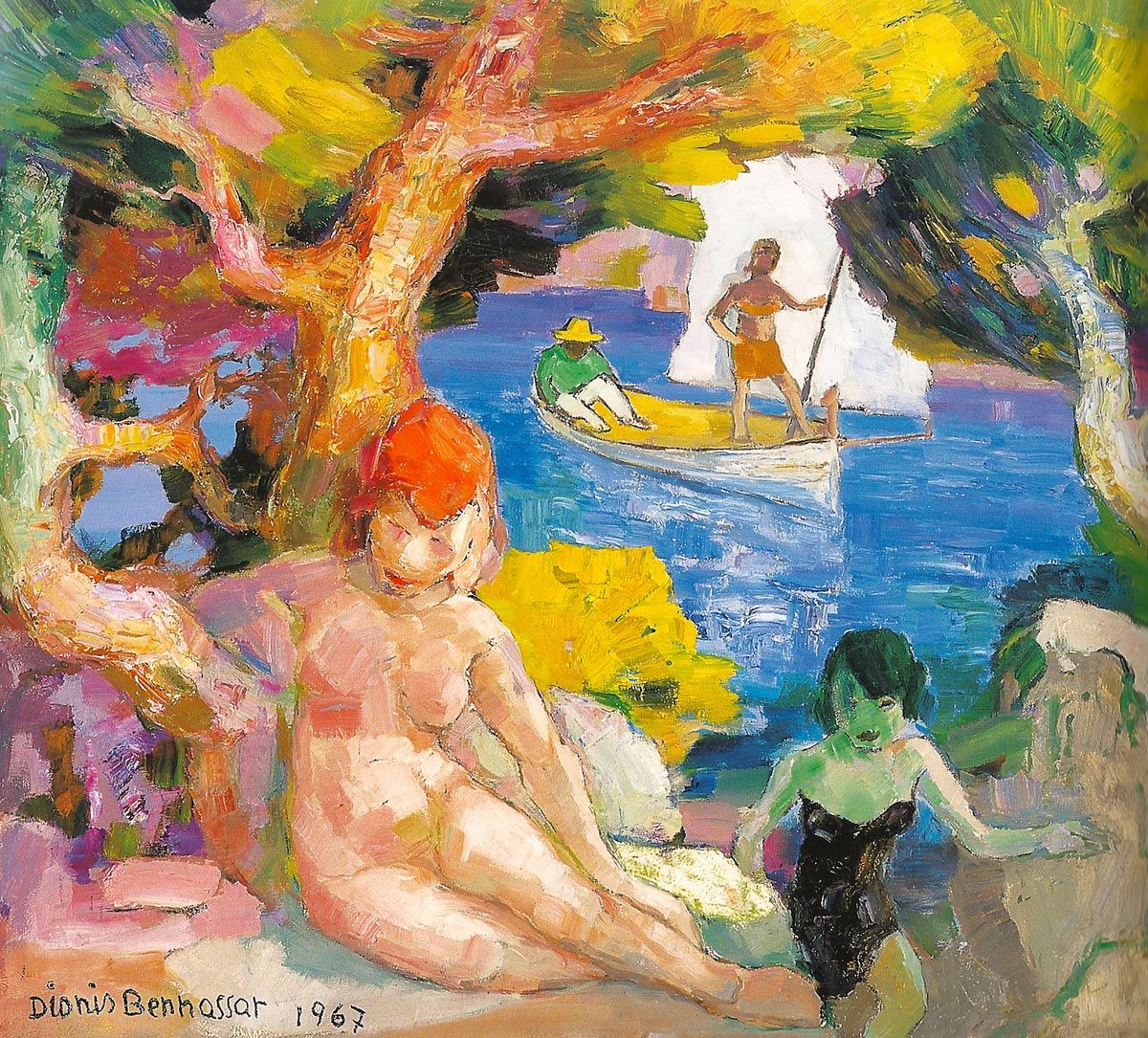
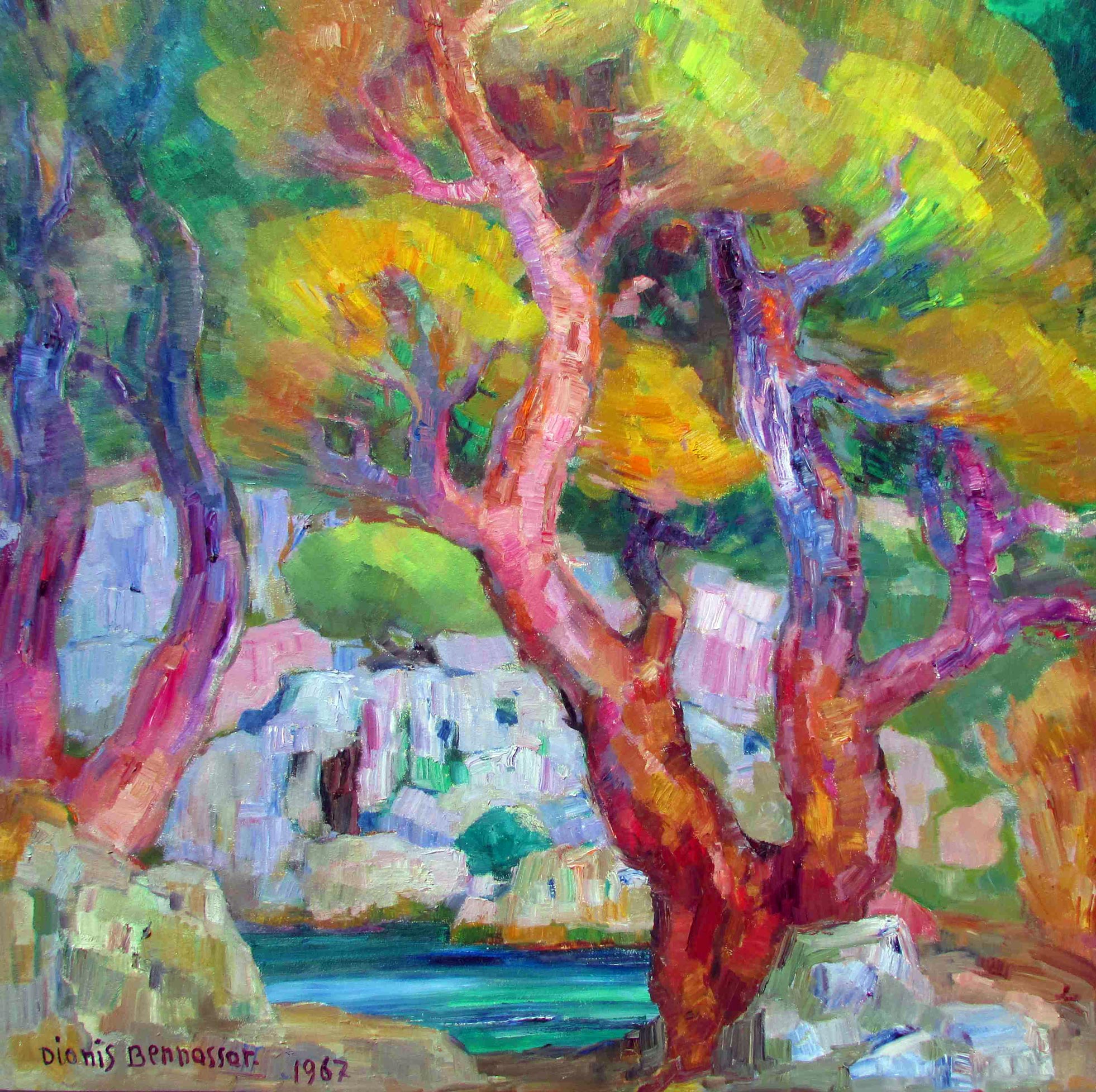
In the last two years before his death in 1967 Bennàssar arrived at something fully his own. The paint is thick and
applied with a confidence that can afford to be wrong on the way to being right. Figures from the agricultural
landscape, farmers and their mules, women resting under olive trees, enter the compositions on equal terms with the
rocks and trees that were always his subject. In Febrero (February, almond blossom time) he painted the
hillside above Pollença in an explosion of pink and white that reads from a distance as pure abstraction. In the
same year, in the coves below the Cavall Bernat, bathers dissolve into a composition of green, blue and orange
that owes nothing to the naturalism in which the school had begun. He had taken what Anglada brought to Pollença
and made it something the maestro could not have made: the view from inside a place, over a lifetime.
Bennàssar · 1966–1967 · the full palette
Figures in the landscape · 1966
Almond blossom, Febrero · 1967
Bathers and boat · 1967
Pines in full colour · 1967
The last year: the colour uninhibited, the brushwork direct, the almond trees above Pollença becoming almost abstract. Bennàssar died in Pollença aged 63, having never left the place that made him. He had made it visible in a way it had never been before.
None of it happened in isolation. The colony was a web of mentors and pupils, friends, marriages, and the hosts who
received everyone, with a few looser threads of influence and shared milieu. Tap any figure to follow their ties;
what emerges is a structure, not a crowd.
Solid threads are documented personal ties; dotted threads are influence or shared circle.
The synthesis
Crossings in time and distance
Now lay the web onto the map. In the chart below, every figure is pinned by when they were on the
island and where they came from, and the connection threads are draped across that grid. A line
that runs long and steep is a friendship that reached back across years and over an ocean. Anglada's atelier
revealed as an Atlantic crossing made local; the native Bennàssar's ties all running upward to the foreigners who
taught him. Graves and Miró arrived late and far to the side, each by a different door.
Horizontal is time, vertical is origin (nearest to farthest), colour is the movement, and the
threads are the connections.
IV · The Architecture of Light
The mountain that curates the sun
It was never merely a matter of Mediterranean sky. What the painters encountered along the northern coast was an optical machine constructed of stone: the Serra de Tramuntana, running like a jagged spine of Jurassic limestone from southwest to northeast. The range does not merely frame the island; it actively shapes its daylight, acting as both reflector and shadow mask.
At dawn, as the sun clears the eastern horizon, its low-angle rays strike the sheer, pale faces of calcarenite and dolomite. The high albedo of the bare rock catches the earliest rose and gold, bouncing it back across the central plain (Es Pla) long before the lowlands receive direct light. The deep mountain passes, such as the collades and valleys of Sóller, Orient, and Pollénça, act as optical pipelines, funnelling long-wave morning light directly into interior basins and coastal villages.
In the evening, the mechanism reverses with dramatic effect. The jagged, uneven profile of the peaks fragments the descending solar disk into discrete crepuscular rays. As the sun dips behind the high ridges, lower elevations drop into early shadow, yet the atmosphere immediately above the crests remains brilliantly lit. The extreme atmospheric path length strips away the short blue wavelengths through Rayleigh scattering, leaving only the purest red, orange, and golden hues. Refracted through high aerosol layers and bounced off western cliff faces, this filtered warmth is cast back across the bays.
It was this physical phenomenon, a prolonged, double-reflected golden hour, that granted the Pollénça painters their extra hour of canvas light each dusk. It is the mechanism behind Anglada-Camarasa's own remark, quoted earlier in this account, that the painters put down their brushes each evening only to applaud.
V · The rupture
When the world broke the colony
In July 1936 the Spanish Civil War broke out, and Mallorca fell almost at once to Franco's Nationalists. The colony
shattered along its fault lines. Anglada-Camarasa, stranded in Republican Barcelona, sat
out the war at the abbey of Montserrat and then spent nine years exiled in France, not coming home to Pollença
until 1948. Robert Graves was taken off Deià by a British warship in 1936 and did not
return for a decade.
Others left for good. The patron Adán Diehl, already ruined by the Crash and the war,
watched the whole village turn out to see him off, and died far away in Buenos Aires. The Mallorcan poet
Gabriel Alomar, who had served the Republic, died a refugee in Cairo. And those who stayed, the native Bennàssar, the Argentine Cittadini, the painter
Pilar Montaner, kept the thread unbroken until the others, and a young Joan Miró, could
return to a changed island.
The fall was literal as well as symbolic. Ramaugé's La Fortaleza, the clifftop fortress above the harbour where the colony had gathered for two decades, was requisitioned by the
Spanish Air Force and converted for military use, its gardens and salons stripped of everything that had made it
a living centre of art. The physical heart of the pre-war commune was extinguished; what had taken years of expense
and care to build was erased in weeks. The golden era had not simply ended. It had been confiscated.
When Anglada finally came home to Pollença in 1948, he was seventy-five. He found the bay, the pines, the light; the studio he had left twelve years earlier. What he did not find was the circle that had animated it. The Argentine painters were long gone; the patron who had turned Formentor into a summer of gold had died far away in Buenos Aires. He went back to work regardless. In the eleven remaining years of his life he produced some of his most luminous canvases: the same bay held at greater distance, the colour grown almost incandescent. The colony had ended. The painter had not.
Where a life-bar breaks, the figure was in exile. Tap any lane for what the rupture meant.
VI · The long afterward
The island, changed
The colony never reassembled as it had been, but the island kept its pull. In Deià, Robert
Graves built a second, literary world around his house Ca n'Alluny; visitors over the years included Kingsley
Amis, Gabriel García Márquez, Alec Guinness and Ava Gardner — drawn there, originally, on a one-line recommendation.
It's paradise — if you can stand it.Gertrude Stein, to Robert Graves
And the greatest name came last. Joan Miró, whose mother and wife were both Mallorcan,
had spent the Franco years abroad; in 1956 he came home to Palma for good and built, with his friend the architect
Josep Lluís Sert, the vast studio he had always dreamed of. He worked there until his
death in 1983. Down the coast, the Hotel Formentor that had ruined Adán Diehl was revived; through its
Conversaciones and the Formentor Prize, founded with Camilo José Cela,
it once again gathered the writers of the world to the bay.
By the time Miró died on Christmas Day, 1983, the island the colony had painted was already a world half-preserved inside institutions. The mass tourism that had reshaped the south of Mallorca through the 1960s and 1970s had reached even the quieter corners; the painters’ bays, the fishing quays, the unpaved tracks were yielding to a different kind of island. Pollença and Deià were sheltered by their geography (too narrow, too steep, too far from the airports), but what they sheltered was now memory as much as landscape. What endured were the institutions that kept the record: the Fundació Bennàssar in Pollença, the Fundació Pilar i Joan Miró in Palma, the summer concerts in the Dominican cloisters. An island that painters had turned into a myth was now teaching that myth back to the visitors who arrived seeking what the painters had seen.
A French novelist's miserable winter; an archduke's forty years; a Paris atelier on a fishing quay; a poet's ruined
hotel; a painter's left hand; a Nobel laureate's late homecoming. The Golden Island held them all.
Coda
The colony in pictures
The story of the colony told through its paintings, in motion.